- All TUH staff conducting research in the Hospital must create an account to register as research staff through the Research Registration Form
- All non-TUH staff who are entering TUH to undertake Research must have a co-investigator who is staff in the Hospital and all non-TUH staff must register with HR through the Research Registration page in Registration Form
- In order to conduct research in TUH, the following are required:
- Garda Vetting – If you are TUH staff this was conducted before you began working in the Hospital
- Insurance and Indemnity are also required – The CIS will cover all staff conducting research however non-staff will not be covered and external insurance is required. An example is TCD staff/students will need to submit a copy of TCDs insurance Contact Details for Garda Vetting: talent.acquisition@tuh.ie
Contact details for medical staff: medical.administration@tuh.ie - In order to conduct research in TUH the following training must be completed:
- Data Protection Training (General training via www.hseland.ie and research specific training via the Research Office, in conjunction with the Centre for Learning and Development (CLD) and via www.hseland.ie)
- ICH-GCP Training – Full Introductory course and Refresher course offered via the Research Office, in conjunction with the CLD and via www.hseland.ie)
- In order to conduct research in TUH the following training may need to be completed depending on the nature of your study. For TUH staff these are mandatory training for employment
- Hand Hygiene (www.hseland.ie)
- An Introduction to Children First (www.hseland.ie)
- Fire Safety
- Manual Handling
- Sharps Education
- Breaking the Chain of Infection
- Personal Protective Equipment
- Basic Life Support training
|
 Dr. Sadhbh O'Neill Scanlon joined the Hospital in 2018 as Research & Ethics Manager and was appointed Head of Research in 2022. She provides strategic leadership for research across the organisation, supporting the development, governance, and delivery of high-quality clinical research.
She has extensive experience in research and clinical trials, with a strong background in research governance, ethics, study management, and research data protection in her capacity as the Hospital’s Research Data Protection Officer (DPO). Dr. O’Neill Scanlon works closely with investigators, sponsors, academic partners, and clinical teams to foster a research-active environment and to support the successful delivery of studies across a range of specialties.
As Head of Research, she oversees research strategy, regulatory and ethical compliance, and the continued growth of the CRF in her role as the Operations Manager. She is committed to promoting excellence in research, strengthening collaboration, and ensuring that all research conducted within the organisation meets the highest standards of scientific integrity, participant safety, and regulatory compliance.
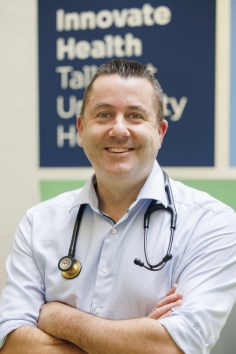 Prof. Patrick Mitchell is a Respiratory Consultant at TUH, Clinical Lead of the CRF, and Associate Professor of Medicine at Trinity College Dublin. He has extensive experience as a Principal Investigator in respiratory clinical trials and has led and supported numerous studies across a range of respiratory conditions.
As Clinical Lead of the CRF, Prof. Mitchell provides strategic and clinical oversight for research activity within the facility, supporting the delivery of high-quality clinical trials and fostering collaboration between investigators, sponsors, and multidisciplinary teams. His academic and research experience contributes significantly to the development and advancement of clinical research within the organisation  Ms. Saoirse Collins is the Clinical Nurse Manager 2 (CNM2) of the CRF and also serves as a Clinical Trial Coordinator. She brings extensive clinical and research experience to the role, having worked for many years as an Intensive Care Unit nurse before moving into clinical research.
Saoirse has significant experience coordinating and managing Phase II and Phase III clinical trials, as well as observational research studies. Her skills include study start-up, participant management, regulatory compliance, and the day-to-day operational delivery of clinical research.
As CNM2, Saoirse is responsible for the daily management of the CRF, ensuring effective research operations and supporting the successful initiation and conduct of studies. She works closely with investigators, sponsors, and multidisciplinary teams to ensure that research is delivered efficiently, safely, and in line with Good Clinical Practice (GCP) and regulatory requirements.
 Ms. Deirdre O'Brien is the Clinical Trials & Studies Contracts Officer for the Research Office. She plays a key role in supporting the efficient start-up of clinical trials and research studies, ensuring clear, timely communication between sponsors and the research site.
Deirdre manages all contractual aspects of study initiation, working closely with sponsors, investigators, and institutional stakeholders to keep research projects moving forward. She also oversees the collection and coordination of research-related data protection documentation, ensuring that all relevant agreements are collated and submitted for review by the Research DPO. Through her expertise and attention to detail, Deirdre helps ensure that studies are established in full compliance with contractual, regulatory, and data protection requirements, contributing to the successful delivery of high-quality clinical research.
 Ms. Caoimhe Murphy is the Administrative Officer & Research Assistant for the CRF, providing essential administrative and operational support to the research team. Her responsibilities include the coordination and management of research data capture, reporting activities, and the organisation of trial participant visits. Caoimhe plays a key role in supporting study screening and the informed consent processes, helping to ensure that research activities are conducted in accordance with ethical, regulatory, and Good Clinical Practice requirements. Through her strong organisational skills and attention to detail, she contributes to the efficient delivery of clinical research studies and supports a positive experience for all research participants.
|
The Research Office was established in 2021 following the publication of the TUH Research Strategy 2021-2024 and in a response to the changing research landscape in Ireland and to meet the needs of researchers within the Hospital. The function of the research Office is laid out in the Organogram below: 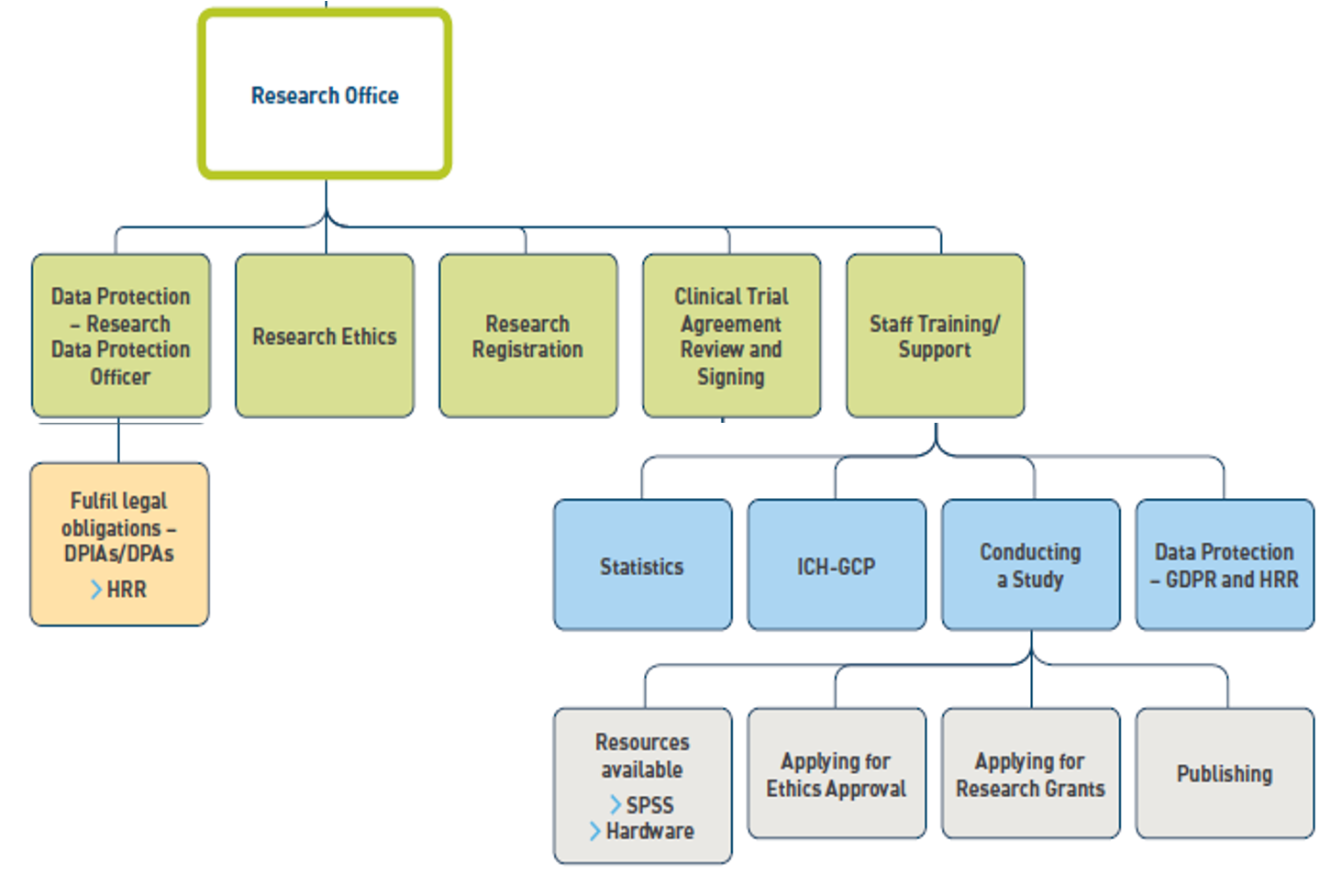
- Research Registration: All research, clinical & non-clinical should be registered with the Research Office through the Registration Form. Registering your research will ensure your research is in compliance with legislation and internal TUH governance procedures. Please see the Research Ethics Committee section for further details.
- Research Ethics: All research involving the recruitment of staff or patients must receive ethical approval before beginning by applying through the Research Ethics Application Form. Please see the Research Ethics Committee section for further details.
- Data Protection: All research is subject to the Data Protection Legislation. Please see Research Data Protection page for further details.
- Clinical Trial and Observational Study Agreement, Material Transfer Agreement, Data Sharing Agreements, Confidentiality Agreements, etc, review and execution: The DCEO is the designated signature for the above agreements in TUH. The Clinical Trials and Studies Contracts Officer is responsible for the review of these agreements and organising execution. Please see the Clinical Trial and Observational Study Agreement Sign Off.
- Staff Training, Development & Support: The Office will offer training such as ICH-GCP training to researchers, Research Data Protection training and ad hoc research training sessions, e.g. Research Ethics Clinics. Resources such as SPSS and networked laptops with remote access are available through the Library and statistical support and training is also available from Ms Miriam Williams, TUH Librarian.
Statistics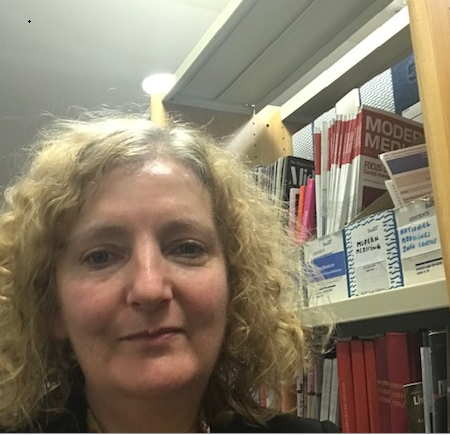 Miriam Williams is a Medical Librarian in TUH. In 2024 she completed a Post-Graduate Certificate in Statistics and Data Science from Trinity College Dublin. She also holds a Bachelor of Commerce and a Higher Diploma in Computer Science (both from UCC) and a Post Graduate Diploma in Library & Information Studies from University of Wales, Aberystwyth.
Miriam delivers a two day introductory workshop in statistics using SPSS. The course covers: descriptive statistics, hypothesis testing, power analysis, regression and correlation. She also provides statistical support to staff and students working with these methods or using SPSS software. Any of these topics and in using SPSS software.
|
Contact Details: Dr. Sadhbh O’Neill Scanlon (Sadhbh.oneill@tuh.ie) directly and cc the ResearchEthics@tuh.ie The Chair of the JREC is Prof Anne-Marie Tobin. Please contact Dr. Sadhbh O’Neill Scanlon and queries will be forwarded to Prof Tobin. PURPOSE OF THE JREC- The St. James’ Hospital (SJH) / Tallaght University Hospital (TUH) Joint Research Ethics Committee (REC) provides ethical review of research studies in which patients, staff and sometimes healthy volunteers are either: - Direct participants
- Their medical records medical data are accessed and collected
- Their biological samples are used
- The aim of the SJH/TUH JREC is to ensure the safety of our participants at all times HOW THE SJH/TUH JREC FUNCTIONS- The SJH/TUH jREC follows the Operational Procedures for RECs Guidance issued by the Irish Council for Bioethics (2004) (available at: Irish Council for Bioethics)
- The full SJH/TUH JREC meets nine times each year and reviews between 6 and 10 applications at each meeting.
- Researchers must submit all research studies to the SJH/TUH JREC for review via the online Ethics Review Manager - Infonetica
- For studies reviewed at a committee meeting, Minutes are written following the meeting and approved by the Chair. Once approved a letter with reviewer comments will be issued to the applicant via Infonetica
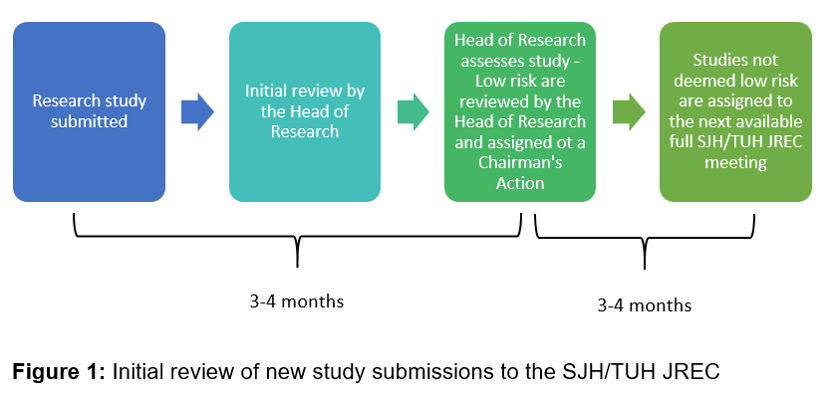
- For Studies reviewed by a Chairman’s Action, the Head of Research will review the submission and liaise directly with the Applicant via Infonetica until ready for approval. The study will then be sent to the Chair for approval and a letter issued once approved.
Figure 1 below illustrates the process of review for a new study submitted for initial review
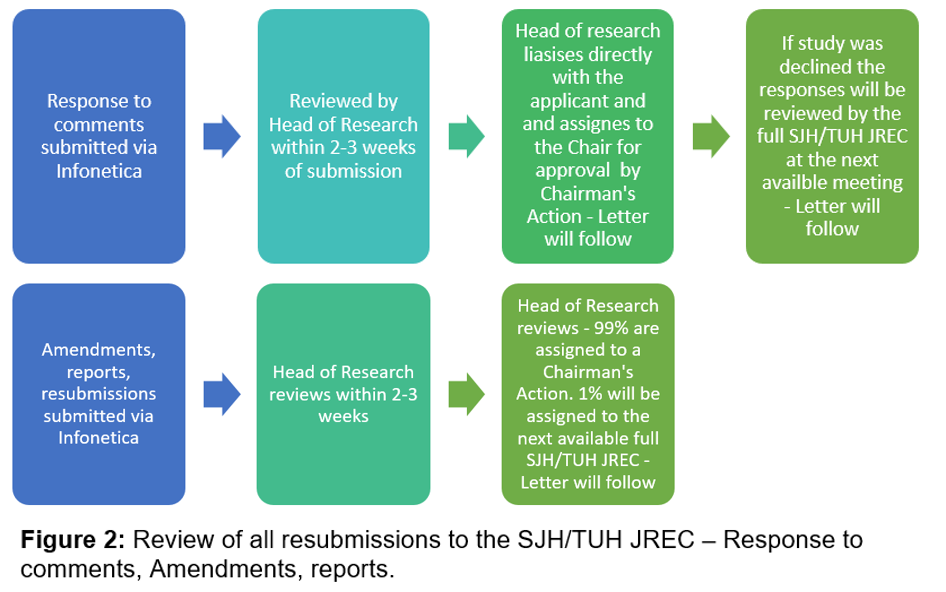
Figure 2 illustrates the process of review for all other types of submissions, i.e. amendments, response to comments, resubmissions, reports
Decisions: The full SJH/TUH JREC issues one of the following decisions in relation to a valid application: - The study is APPROVED (Final Opinion): The applicant may conduct the research as outlined in the application form submitted to the SJH/TUH JREC incorporating any requirements by the SJH/TUH JREC.
- The study is APPROVED pending CLARIFICATIONS: The study can begin once clarifications are submitted to the SJH/TUH JREC via the correspondence section of Infonetica.
- The study is PROVISIONALLY APPROVED: The study is approved subject to recommended revisions to the application and/or responses to questions posed. The applicant must resubmit any revisions and/or responses to the SJH/TUH JREC before receiving final approval for the study. No research may be conducted prior to receiving final approval.
- Further Information required: The SJH/TUH REC requires further information from the applicant and/or referee (expert opinion) before a decision can be reached.
- The study is DECLINED: The applicant is given a full explanation of the REC’s decision with or without an invitation to resubmit a substantially altered proposal for reconsideration.
The Chairman’s Action issues the following decisions in relation to a valid application: - The Head of Research liaises directly with the applicant requesting additional information.
- Once all queries are addressed and the application is ready to be approved the Head of Research will send the application to the Chair for Chairman’s Approval via Infonetica. Subsequently an approval letter will be issued via Infonetica.
ADDITIONAL INFORMATIONHealth Research Consent Declaration Committee (HRCDC):Researchers conducting studies involving patients who lack capacity to give their own informed consent or researchers who do not plan on seeking explicit consent from the patient must apply to the HRCDC for a consent declaration for the processing of the patients data. Provisional SJH/TUH JREC approval must be in place before applying to the HRCDC. This type of study will require a full SJH/TUH JREC review and is not eligible for a Chairman’s Action. Health Products Regulatory Authority (HPRA): Research involving Investigational Medicinal Products or Devices may require approval from the HPRA. Please consult with the HPRA regarding your study before applying to the JREC. Committee Meeting Dates 2026 and 2027: - September 16th 2026
- October 21st 2026
- November 18th 2026
- January 20th 2027
- February 24th 2027
- Mar 31st 2027
- April 21st 2027
- May 19th 2027
- June 16th 2027
- September 15th 2027
- October 20th 2027
- November 17th 2027
All submissions made to the JREC are reviewed and assigned to the next available meeting. It is not possible to submit for a particular meeting. 90% of submissions are approved via a Chairman’s Action and 10% via a full JREC Meeting. The Head of Research determines eligibility for a Chairman’s Action. TYPES OF STUDIES THE SJH/TUH JREC REVIEWClinical Audit: Clinical audit is the systematic review and evaluation of current practice against standards with a view to improving clinical care for service users Quality Improvement Initiatives: Improving quality means making healthcare safe, effective, patient – centred, timely, efficient and equitable.
Quality Improvement (QI) provides a structured approach to enhancing how care is delivered. Because healthcare is made up of thousands of interlinked processes, QI involves defining these processes, measuring and analysing, them, implementing improvements and ensuing those improvements are maintained. Service Evaluation: An internal evaluation of a service provided to a select set of patients for a given period of time in order to identify issues/good practice and implement appropriate changes if necessary. ** The JREC will not review these types of studies ethically but the JREC will issue a letter stating the type of study being conducted** - Registration is made via the Registration Form Contact Details: Ms Sinead Palmer, Quality & Change Manager – Sinead.Palmer@tuh.ie, 01-414 2855
|
TUH Research Data Protection Officer: Dr. Sadhbh O’Neill, Saidhbh.ONeill@tuh.ie - The General Data Protection Regulation (GDPR) was signed into law on the on the 28th May 2018 for all of Europe (https://gdpr-info.eu/)
- Irelands Interpretation of GDPR, namely the Data Protection Act of 2018 (http://www.irishstatutebook.ie/eli/2018/act/7/enacted/en/html) was implemented in Ireland on the 8th August 2018.
- The Department of Health (DoH) in Consultation with the Data Protection Commission (DPC) (https://www.dataprotection.ie/) published the Health Research Regulations 2018 (http://www.irishstatutebook.ie/eli/2018/si/314/made/en/pdf), which is Irelands Interpretation of GDPR/Data Protection Act 2018 for Health Research.
- And it’s amendments (https://www.irishstatutebook.ie/eli/2021/si/18/made/en/print)
- Therefore all Health Research taking place in Ireland is subject to the GDPR, the Data Protection Act and the Health Research Regulation
- What does this mean for Health Research in Ireland?
GDPR, the Data Protection Act of 2018 and the Health Regulations (HRR) required consent to be sought for all research taking place. However in January 2021 amendments to the HRR were enacted by the DoH and the Data Protection Commission. These amendments concerned a number of areas but of particular interest to researchers are the amendments to: - Retrospective Chart Reviews - Consent is no longer required for this type of study BUT only when the study meets certain low risk criteria: (i) the data is protected by a unique coding system (ii) a data protection risk assessment has concluded that the study is low risk (iii) it is performed by a healthcare practitioner who is an employee of TUH or a student healthcare practitioner (iii) is another employee of TUH who in their normal duties has access to medical records (iv) the data will not be shared unless completely anonymous (v) the published results will not identify any individual and (vi) the Research Ethics Committee must review and approve the study.
- Pre-screening – pre-screening is the process researchers used to identify patients that may be suitable for the research study they wish to undertake. This involves accessing medical records for the purpose of identifying patients but no data is removed/copied/recorded prior to consent. This can only be conducted by a healthcare practitioner employed by the controller (hospital, primary care centre, GP practice etc) or a person studying to be a health practitioner who is under the direction and control of the controller. That means that there are formal governance arrangements in place that include specifying that the controller rather than the supervising health practitioner is responsible for all data protection matters relevant to the student; • An employee of the controller (for example, a medical records clerk) who in the course of his or her duties for the controller, would ordinarily have access to the personal data of individuals held by the controller (that were obtained for the provision of health care to those individuals); or • A person referred to an “authorised person” (see next slides). Who can be an authorised person? The amendment specifies certain persons who can be authorised by the controller holding the personal data to carry out the pre-screening element of health research without explicit consent. Those persons can be employees of the following organisations: (a) an institution of higher education within the meaning of section 1(1) of the Higher Education Authority Act 1971 (No. 22 of 1971), (b) a body or person that has as its principal activity the provision, management or development of a health practitioner, or (c) a registered charitable organisation within the meaning of the Charities Act 2009 (No. 6 of 2009), one of whose objects is to support research and education in the health services. Should they be deemed suitable they will be contacted in order to provide them with information about the study and, if they feel comfortable and happy, to obtain their consent. This first contact should be made health practitioner of the controller or an authorised person who is a health practitioner.
- Health Research Consent Declaration Committee
- Research involving patients who lack capacity to provide their own informed consent for their participation in research require a consent declaration by the Health Research Consent Declaration Committee (HRCDC)
- The data controller must apply to the HRCDC for a consent declaration
- The HRCDC is a separate committee to the Ethics committee. Their role is to review applications regarding the processing of a patient's data without seeking consent from the patient
I. Personal data (i.e. name. address, MRN, email address, DOB, etc)
II. Personal sensitive data (i.e. patients medical data)
- The HRCDC committee make a decision as to whether there is significant public interest in the study and this public interest outweighs an individual's right to give their consent for their data to be processed
- The HRCDC will require assent to be sought from the patient’s proxy.
- More information and the HRCDC application form can be found at the link above
Consent for Health Research must be dual consent, (i) consent for participating in research and (ii) consent for processing a patient’s data. The DoH have published their guidance for seeking explicit consent from patients. Please also consult the HSE consent policy for health and social care research (https://www2.healthservice.hse.ie/organisation/national-pppgs/hse-national-policy-for-consent-in-health-and-social-care-research/)
|
The review and execution of Clinical Trials & Studies contracts is managed by Dr. Sadhbh O’Neill Scanlon (Sadhbh.oneill@tuh.ie).
Ms. Deirdre O’Brien, the Clinical Trials and Studies Contracts Officer is the first line of contact for contract review and execution. Deirdre is available from Tues to Fri 9:30am – 3:30pm at deirdre.obrien02@tuh.ie or (01) 414 2952. Clinical Trial Documentation
The following documents are required to be reviewed for a Clinical Trial: - Sponsor DPIA or Sponsor Statement of Compliance to accompany the TUH Data Protection Compliance Form
- Clinical Trial Agreement (CTA) / Contract / Research Collaboration Agreement
- The sponsor, or legal representative of the sponsor must be established within the European Economic Area
- Including Financial Appendix / Budget
- Budget should include CTA/DPA Review Fee of €3,000
- Data Protection Agreement (DPA) - Can be a section in the contract, appendix or standalone document
- Site Specific Assessment (SSA) or Site Specific Template (SST). Must be signed and dated by Principal Investigator
- Clinical Trial Indemnity Form - State Claims Agency template, Version 4 to be used
- Research Ethics Committee favourable opinion, CTIS Approval Part 1. Must list TUH as a site and TUH Principal Investigator name
- HPRA granted Authorisation for Clinical Trial – CTIS Part 2 approval
- Sponsor Insurance Certificate
- The following documents may also be requested:
- Letter of Authorisation/delegation of Authority
- Standard Contractual Clauses (SCCs)
- Transfer Impact Assessment (TIA)
- HRCDC Approval
The following documents are required to be reviewed for an Observational Study: - Data Protection Impact Assessment (DPIA) – Section 4 of the SJH/TUH JREC Application form
- Observational Study Agreement / Contract
- The sponsor, or legal representative of the sponsor must be established within the European Economic Area
- Including Financial Appendix / Budget, if applicable
- Data Protection Agreement (DPA). Can be a section in the contract, appendix or standalone document
- Research Ethics Committee favourable opinion. Must list TUH as a site and TUH Principal Investigator name.
- The following documents may also be requested:
- HPRA granted Authorisation for Clinical Trial
- Sponsor Insurance Certificate
- Letter of Authorisation/delegation of Authority
- Standard Contractual Clauses (SCCs)
- Transfer Impact Assessment (TIA)
- HRCDC Approval
When this documentation is reviewed and agreed, we make a submission to AON for approval through the Clinical Indemnity Scheme. On receipt of this final approval we can proceed to signing the contract.
Please Note: - The Deputy CEO must be the final signature on the contract after all the documents outlined above are approved for sign off by the Clinical Trials and Studies Contracts Officer
- The Adelaide and Meath Hospital, Dublin, incorporating The National Children's Hospital is the legal name for TUH and must be used on all documentation
- The Principal Investigator, Pharmacy, CRF CNMII, Radiology and other stakeholder departments within TUH must approve the budget
- Where the Pharmacy Department (pharmacy.clinicaltrials@tuh.ie) are involved in the trial they must approve the pharmacy budget. This approval must be sent to the Clinical Trial and Studies Contracts Office
Research Human Resources - All TUH staff conducting non-clinical research in TUH must create an account to register as research staff and their study through the Research Registration Form on Infonetica.
- All TUH staff conducting research must be the PI or listed as a Co-Investigator on each study they are delegated to conduct.
- All non-TUH staff who are entering TUH to undertake Research must have a co-investigator who is a staff member in TUH and all non-TUH staff must complete all HR processes before being on site in TUH and before conducting any study related duties.
- In order to conduct research in TUH and are not a TUH staff member, the following are required:
- Garda Vetting –TCD vetting within the last year is accepted
- Insurance and Indemnity are also required – Non-staff will need their own employer to have research insurance in place and a copy must be provided to the Research Office external insurance is required, e.g. TCD staff/students will need to submit a copy of TCDs insurance
- Research staff registration form, with CDA, Vaccination declaration and training competed, required.
- Authorised persons form
-HR registration from - Please contact research.ethics@tuh.ie & Caoimhe Murphy - Caoimhe.Murphy@tuh.ie (CRF Admin & Research Assistant) to start the above process.
|
The TUH Research Office and SJH Research & Innovation Office in conjunction with the SJH/TUH Joint Research Ethics Committee operate an online portal for Research governance and Ethics review. The portal reviews the following applications: - The registration of all research (clinical & non-clinical) taking place in the Hospital
- For applications requiring Research Ethics Committee review and approval
- Research Data Protection
- TUH clinical audit/service evaluation/quality improvement initiative registration and reporting
- SJH clinical audit/service evaluation/quality improvement initiative Research Ethics Committee letter requests
- SJH R&I review and approval (internal governance for all SJH studies)
- TUH Clinical Research Facility Capacity Assessment and Clinical Trial registration
The link to Infonetica can be found HERE.
The following video is provided to offer guidance to applicants when using the system.
|
- Ideally, all research funding for research taking place in TUH should be lodged into the TUH bank account, where possible.
- These fund are RING-FENCED into an internal IO number under the PIs name.
- The IO can be set up by the Head of Research
- Funds can be spent as per funding agreement.
- Head of Research/Research Office manages fund in and out of these accounts on behalf of the PI.
|
The Clinical Research Facility is a dynamic and expanding department dedicated to advancing patient care through excellence in clinical research. The multidisciplinary team is led by the Head of Research, Dr Sadhbh O'Neill Scanlon, and Clinical Lead, Prof. Patrick Mitchell, and includes Clinical Nurse Manager and Clinical Trial Coordinator, Saoirse Collins; Contracts Officer, Deirdre O'Brien; and Research Assistant, Caoimhe Murphy.
The CRF works closely with key hospital departments, including the Cancer Clinical Trials Office, Radiology, Pharmacy, and the Meath Laboratory, to ensure the seamless delivery of research studies from start-up to completion. This integrated approach supports efficient study conduct, timely sample processing, and consistently high standards of patient care.
As a research-active facility, we are committed to providing a supportive environment for investigators, sponsors, and participants. We deliver clinical trials to the highest standards of quality, safety, and regulatory compliance, adhering to the principles of Good Clinical Practice and maintaining a strong focus on participant experience.
Our growing research portfolio reflects our commitment to innovation, collaboration, and the generation of evidence that improves outcomes for patients and contributes to the advancement of healthcare. CONTACT DETAILS:
Saoirse.Collins@tuh.ie, 087 220 2614, Deirdre.obrien@tuh.ie or Sadhbh.oneill@tuh.ie Information for Sponsors - The TUH CRF employs a structured governance framework to facilitate an efficient and responsive feasibility assessment process. During the feasibility stage of a clinical trial, application forms are completed and submitted to the relevant healthcare departments required for trial delivery, including Pharmacy, Radiology, and Laboratory Services.
- Should any issues arise during this process, every effort is made to support the relevant department in addressing challenges associated with trial delivery. The CRF works collaboratively with all stakeholders to identify practical solutions and ensure that trial activities can be conducted effectively. As a busy academic hospital, TUH is committed to overcoming the day-to-day challenges associated with clinical research and maintaining a supportive environment for trial conduct.
- TUH is strongly committed to expanding its clinical research portfolio and has established the growth of clinical trial activity as a key strategic objective for the organisation.
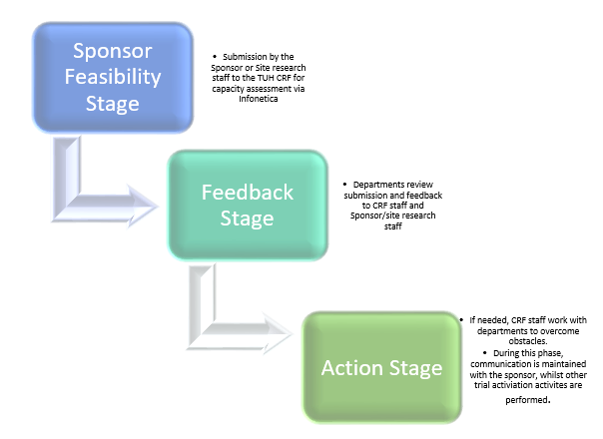 During the site feasibility stage of a clinical trial, the Research Office/CRF uses Infonetica to manage and communicate the feasibility assessment process. Applicants must provide study details and then select the resources required for their study. The most commonly requested resources are Pharmacy, Radiology, and the Meath Laboratory. If additional resources are required, applicants outline these additional resources in the assessment form and the CRF CNMII will liaise with that department to assess capacity. Pharmacy capacity assessment is the first step in the process, where applicants complete a Clinical Trial Feasibility Form and provide details of the investigational medicinal product (IMP), storage requirements, expected stock levels, and relevant pharmacy manuals. The Pharmacy Clinical Trials Team reviews the application and may request further information through Infonetica. The Pharmacy Clinical Trials Team will notify the applicant is capacity is confirmed or liaise directly with the Research Office/CNMII if capacity is not available at this time. The application then progresses to Radiology (where required), followed by the Meath Foundation Laboratory. Each department reviews the study requirements and may request additional information via Infonetica. Confirmation of capacity are sent at each stage and a final letter of TUH capacity is sent at the end of the process.
Throughout the process, Infonetica acts as the central platform for applications, departmental reviews, and communication between applicants and the relevant teams
|